Rear Wheel Cylinders and Handbrake Draw Link Assembly
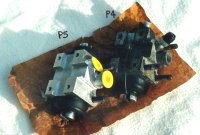 The rear cylinders for the P4 are getting pretty scarce, with original Girling parts as rare as rocking horse droppings.
John Wearing had some in June 1999 but this must be exceptional luck.
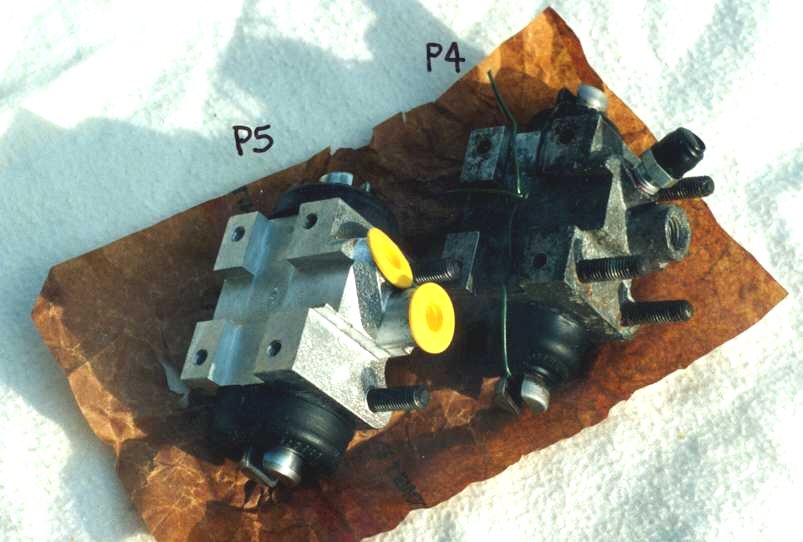
The good news is, you can fit P5 rear cylinders to a P4. The bore is 7/8 inch giving increased braking at the rear.
I have tried this and found it to be quite satisfactory.
As you can see the P5 cylinders have only 2 mounting studs whereas the P4 cylinders had 3.
Click on this picture for a larger one.
The rear cylinders for the P4 are getting pretty scarce, with original Girling parts as rare as rocking horse droppings.
John Wearing had some in June 1999 but this must be exceptional luck.
The good news is, you can fit P5 rear cylinders to a P4. The bore is 7/8 inch giving increased braking at the rear.
I have tried this and found it to be quite satisfactory.
As you can see the P5 cylinders have only 2 mounting studs whereas the P4 cylinders had 3.
Click on this picture for a larger one.
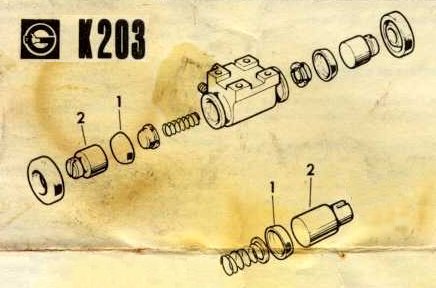 Here is an exploded view of the rear wheel cylinders.
Note that there seem to be two different types of alloy plug that the spring rests on behind the seal.
Mine were like the illustration at the bottom.
Here is an exploded view of the rear wheel cylinders.
Note that there seem to be two different types of alloy plug that the spring rests on behind the seal.
Mine were like the illustration at the bottom.
Rebuilding these cylinders can be fraught with problems. The pistons can corrode in the bores,
which can become scored. Very light scoring can be polished out providing you are satisfied that it will be safe to do so.
The hydraulic connections can corrode horribly and be difficult to remove.
A special brake pipe spanner is a worth-while purchase to avoid everything getting chewed up.
Often the pipe will twist and snap and have to be replaced too.
The threads can strip because they have been weakened by corrosion or overtightening in the past.
The casting can even fracture when the connections are re-made. Beware!
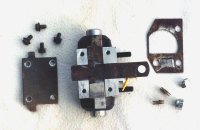 Here's a picture showing how the draw link is fitted in to the rear wheel cylinders.
It is advisable to dismantle and clean these periodically since an accumulation of dust and other muck tends to
clog them up after a while. You can do this with the cylinders still on the car,
and without removing the brake shoes providing you can wedge the brake shoes apart to keep the them off the
handbrake tappets. Obviously the hand brake must be released at the time also.
Here's a picture showing how the draw link is fitted in to the rear wheel cylinders.
It is advisable to dismantle and clean these periodically since an accumulation of dust and other muck tends to
clog them up after a while. You can do this with the cylinders still on the car,
and without removing the brake shoes providing you can wedge the brake shoes apart to keep the them off the
handbrake tappets. Obviously the hand brake must be released at the time also.
Clean up the clevis connecting the draw link to the brake cross rod, remove the remains of the split pin
from the clevis pin, and unscrew the clevis pin using a broad bladed screwdriver.
If it is jammed solid, there are flats on the threaded end of the clevis pin which you may be able to fettle
up and get a small spanner on. Next remove the cover plate and the thing should come apart for cleaning.
At this point it is advisable to check that the cylinder can still slide relatively freely on the back plate.
If it won't loosen the three fixing nylock nuts that hold the cylinder against the back plate and
gently tap the body of the cylinder using a piece of wood to break the bond, then slide it about a bit to free it up.
Do not be tempted to remove the hydraulic connections to the cylinder when doing this job.
When it is sliding nicely re-tighten the securing nuts and then back them off one turn so the cylinder is still free
to slide. You can now reassemble the draw link rollers and tappets as shown above using copper slip grease or similar.
Do not use ordinary grease as this may melt and contaminate the brake linings!
Finally refit the cover plate and release the brake shoes.
If you have to buy new rear wheel cylinders, remember that the draw link assembly is not supplied with them.
Some suppliers are able to supply them however. See the SPARES AND SUPPLIES page for details.
BACK TO THE TECHNICAL MENU
HOME
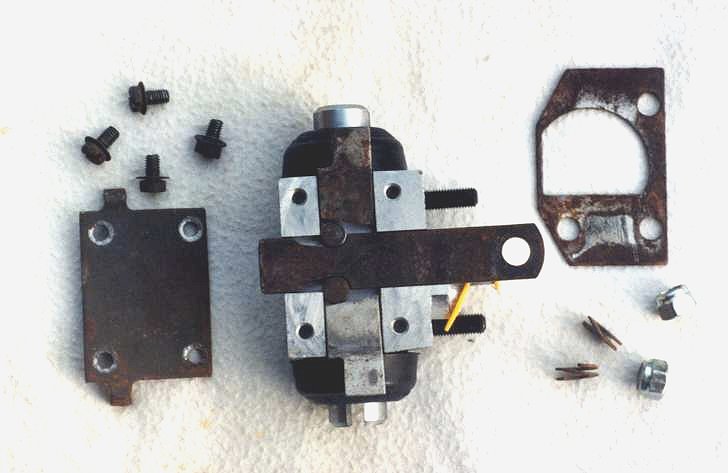 Here's a picture showing how the draw link is fitted in to the rear wheel cylinders.
It is advisable to dismantle and clean these periodically since an accumulation of dust and other muck tends to
clog them up after a while. You can do this with the cylinders still on the car,
and without removing the brake shoes providing you can wedge the brake shoes apart to keep the them off the
handbrake tappets. Obviously the hand brake must be released at the time also.
Here's a picture showing how the draw link is fitted in to the rear wheel cylinders.
It is advisable to dismantle and clean these periodically since an accumulation of dust and other muck tends to
clog them up after a while. You can do this with the cylinders still on the car,
and without removing the brake shoes providing you can wedge the brake shoes apart to keep the them off the
handbrake tappets. Obviously the hand brake must be released at the time also.