Inlet Rockers and Rocker Shaft Wear on the 110
 The rockers and shafts both wear. On the 110, the top rockers have bushes but the side ones don't.
The top rocker shaft is rather thin and seems to wear badly. It is also rather soft.
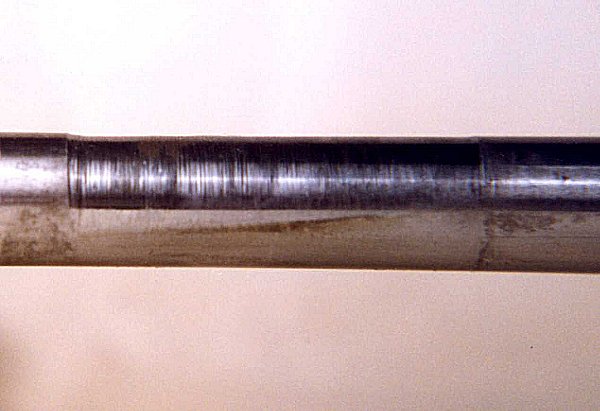
In this picture the rocker shaft has been turned over to show the wear which occurs on the underside.
You can see that there is more wear at one end of the rocker than the other.
This is common so there must be something inherent in the design which tends to twist the rocker sideways.
The rockers and shafts both wear. On the 110, the top rockers have bushes but the side ones don't.
The top rocker shaft is rather thin and seems to wear badly. It is also rather soft.
In this picture the rocker shaft has been turned over to show the wear which occurs on the underside.
You can see that there is more wear at one end of the rocker than the other.
This is common so there must be something inherent in the design which tends to twist the rocker sideways.
By clicking on this picture you can see that there also seem to be two positions of wear,
shown as two steps at the left hand end. (also just visible at the right hand end!)
This is probably due to the mechanism being disturbed at some point,
and emphasises the necessity when re-assembling any worn machinery,
that all the parts must end up in exactly the same working positions as before.
The surfaces of mating parts will have worn with matching profiles so the force is still properly distributed.
Mismatching on reassembly will concentrate the pressure on the high points and cause more rapid wear in the long run.
The top rocker shaft on the 110 is symmetrical front to back with the exception of the oil supply hole at the rear,
so it is possible to turn it upside down and front to rear after drilling a new oil supply hole.
The original hole is covered by the front rocker shaft clamp.
The rear clamp has a corresponding hole in it through which the oil passes to the shaft
and this can be used as a guide when drilling the new oil feed hole in the shaft.
There is also a hole for the locating bolt, which will need drilling.
The top of the shaft is therefore now underneath forming the new wearing surface,
and the oil feed holes for each rocker still face the push rods.
By re-bushing the rockers both the wearing surfaces are now new and a significant amount of wear can be taken out this way.
Be very careful to remove all swarf that may have got inside the shaft before reassembly,
otherwise your hard work will have been wasted.
These top rocker shafts have just recently become available again
and given the work involved removing the head and stripping the valve gear,
it's definitely a better idea to fit a new one if you can afford the £120.00 asking price.
 In this picture you can see how the valve stem has worn away the end of the rocker.
Notice that here too the wear is not even across the area of contact, because the rocker twists
as the rocker shaft wears, as shown above. The surface also seems to be breaking up.
I have no idea if these rockers are case hardened, but this would seem to suggest so.
Some people advocate re-surfacing the rocker ends on an oilstone, but I am tempted to leave the job to an engineering
firm who can get a true surface and then re-case harden it.
In this picture you can see how the valve stem has worn away the end of the rocker.
Notice that here too the wear is not even across the area of contact, because the rocker twists
as the rocker shaft wears, as shown above. The surface also seems to be breaking up.
I have no idea if these rockers are case hardened, but this would seem to suggest so.
Some people advocate re-surfacing the rocker ends on an oilstone, but I am tempted to leave the job to an engineering
firm who can get a true surface and then re-case harden it.
On reflection I don't think the inlet valve gear on the 110 is really up to the high standard set by the rest of the engine.
BACK TO THE TECHNICAL MENU
HOME
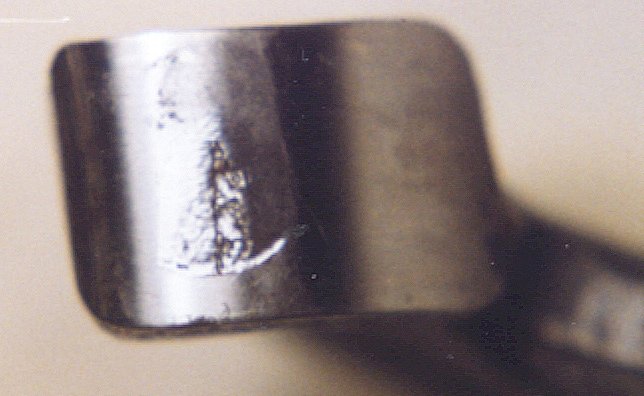 In this picture you can see how the valve stem has worn away the end of the rocker.
Notice that here too the wear is not even across the area of contact, because the rocker twists
as the rocker shaft wears, as shown above. The surface also seems to be breaking up.
I have no idea if these rockers are case hardened, but this would seem to suggest so.
Some people advocate re-surfacing the rocker ends on an oilstone, but I am tempted to leave the job to an engineering
firm who can get a true surface and then re-case harden it.
In this picture you can see how the valve stem has worn away the end of the rocker.
Notice that here too the wear is not even across the area of contact, because the rocker twists
as the rocker shaft wears, as shown above. The surface also seems to be breaking up.
I have no idea if these rockers are case hardened, but this would seem to suggest so.
Some people advocate re-surfacing the rocker ends on an oilstone, but I am tempted to leave the job to an engineering
firm who can get a true surface and then re-case harden it.