Swivel Pin Thrust Race Replacement
This is not a difficult job and the instructions in the workshop manual are quite good.
Wear in the thrust race is easily caused by poor or incorrect lubrication and can be detected by jacking the car
up securely under the suspension, so taking all the load off the kingpin,
and testing for vertical movement of the stub axle on the kingpin as the wheel is lifted up and down.
On my car there was about 1/8th of an inch vertical movement of the stub axle.
Although this is not in its self serious it is not a good idea because it can cause more rapid wear of the kingpin bushes,
and oil seals, replacement of which is neither cheap nor easy.
I also found that the piston action of the kingpin in combination with the viscosity of the oil caused some oil to be
forced out past the oil seals when the car was driven!
If you can waggle the wheel so that by grasping it at 6 o'clock the top and bottom can be pushed in and out this
may indicate that the kingpin and bushes have already worn badly, and it is pointless to renew only the thrust race.
Before panicking check carefully where the movement is occurring, it could also be due to the wheel bearings,
which are designed to have slight free play, or worn rubber suspension bushes,
the fixing of which are much cheaper and easier jobs.
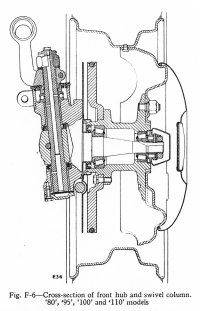
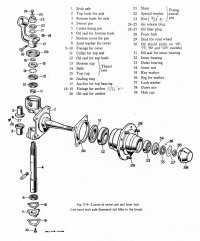
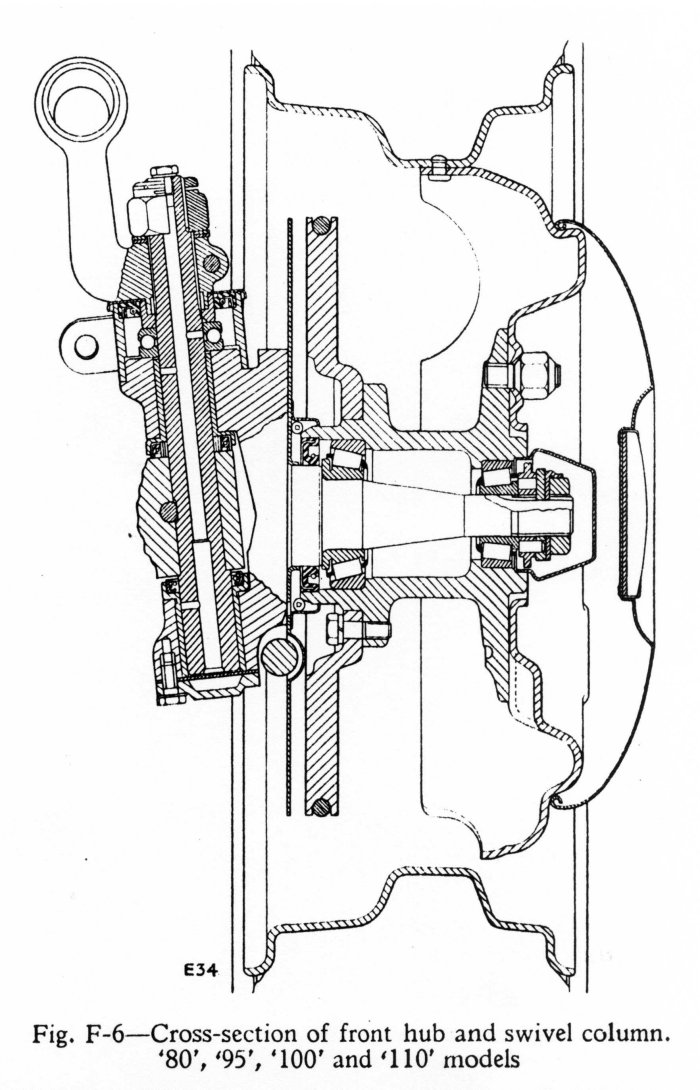
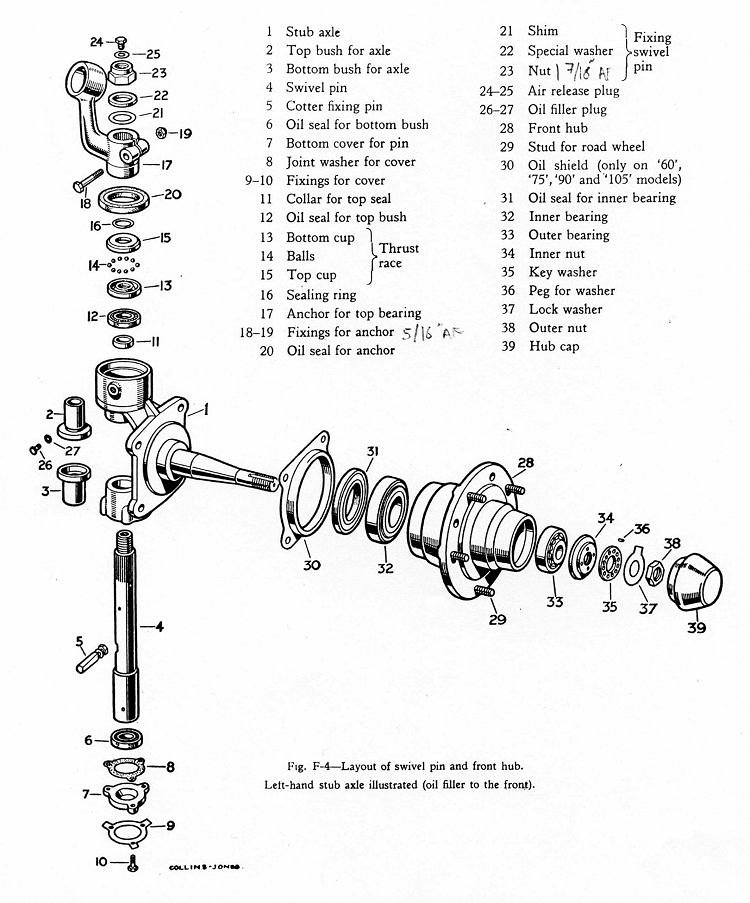
Here are exploded and sectional views of the assembly taken from the workshop manual.
You can click on them for a bigger version if you like!
The vertical load is taken by a thrust race contained in the bulbous oil reservoir at the top of
the stub axle assembly (1).
The top nut (23) screws down against a shoulder on the king pin (4) pushing the top anchor (2)
down the splines on the top of the king pin onto the top bearing cup (15).
The free play is determined by the thickness of the shims under the nut.
These pictures give the general idea. Again, you can click on each picture to see a larger version.
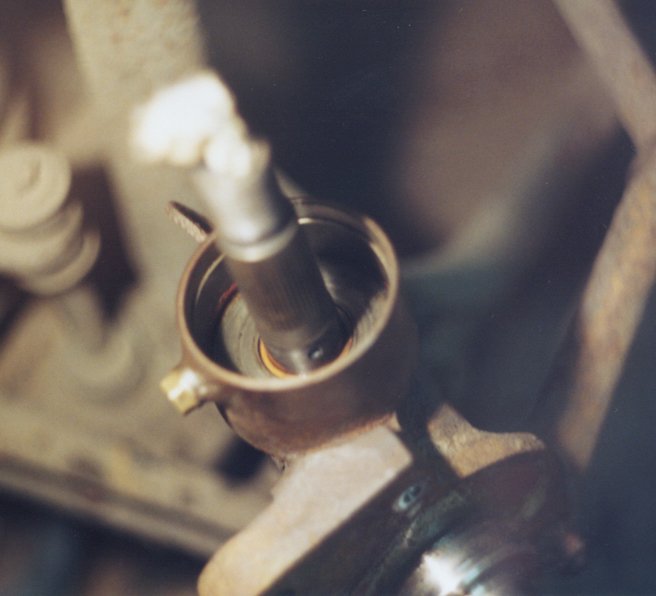
Note that I have pushed a rag into the air release hole to prevent ingress of dirt.
and that the metal cover over the oil seal is not shown in the exploded view.
Odd...
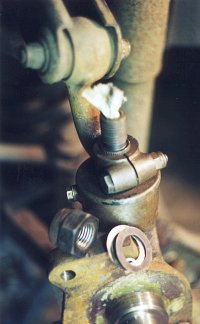 This picture shows the top nut and shims removed from the swivel pin.
You will need a 1and7/16 inch open ended spanner for this.
The splines that the top anchor slides on are just visible.
This picture shows the top nut and shims removed from the swivel pin.
You will need a 1and7/16 inch open ended spanner for this.
The splines that the top anchor slides on are just visible.
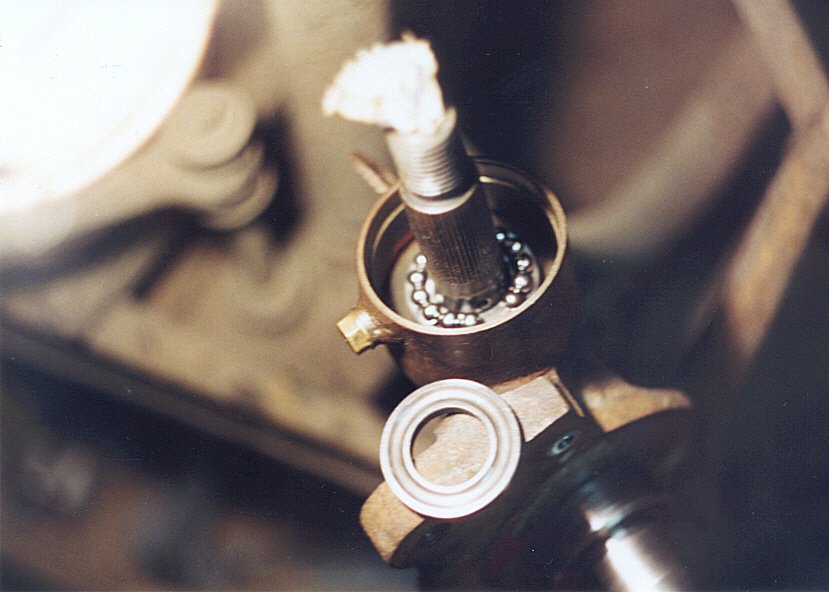
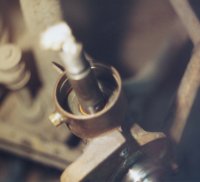 Here the top anchor has been withdrawn and the oil seal levered out with a screwdriver.
The thrust race cups have been lifted out using a couple of L shaped bits of stiff wire,
which can be worked under the bottom cup.
The oil reservoir has been cleaned out ready for fitting the new race.
Note that the top of the top swivel pin bush (orange) can be seen in the bottom of the oil reservoir,
if the bushes are worn you will see play here.
Here the top anchor has been withdrawn and the oil seal levered out with a screwdriver.
The thrust race cups have been lifted out using a couple of L shaped bits of stiff wire,
which can be worked under the bottom cup.
The oil reservoir has been cleaned out ready for fitting the new race.
Note that the top of the top swivel pin bush (orange) can be seen in the bottom of the oil reservoir,
if the bushes are worn you will see play here.
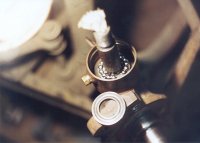 Finally, the bottom race has been dropped into place, the 14 ball bearings are in position
and the top race is ready to be fitted.
Do not be tempted to add a 15th ball!
Finally, the bottom race has been dropped into place, the 14 ball bearings are in position
and the top race is ready to be fitted.
Do not be tempted to add a 15th ball!
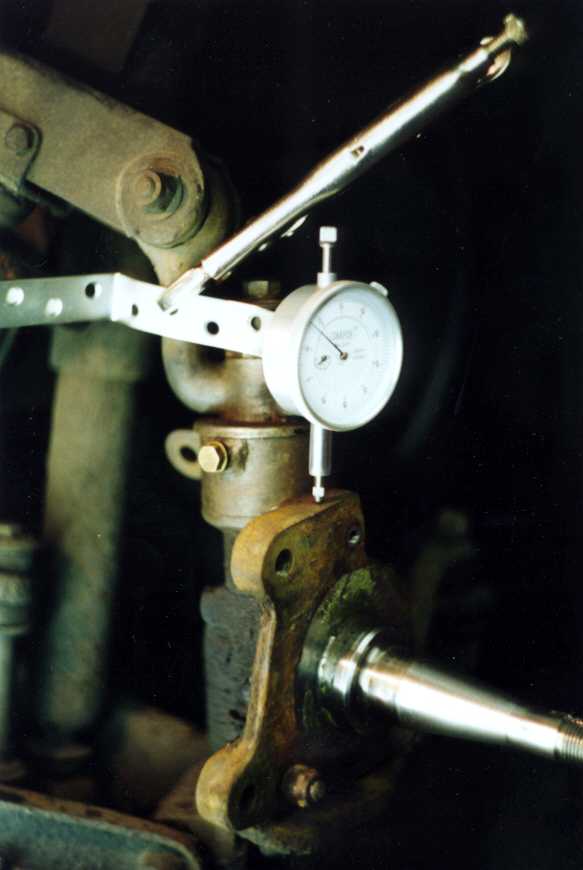
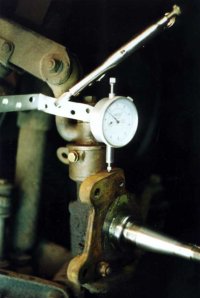 Set the end float to a maximum of 0.003 inches (ie. no pre-load) by inserting or removing shims as required.
Do this without the oil seal or sealing ring in place, to avoid a false reading.
The method of attaching the dial gauge shown here is not recommended because the anchor can move on the splines giving a
false reading if you're not careful. It's better to clamp the gauge to the kingpin nut. Do as I say, not as I do!
When you are happy with the setting, smear the splines with grease to prevent corrosion,
and assemble the unit complete with oil seal and ring.
Set the end float to a maximum of 0.003 inches (ie. no pre-load) by inserting or removing shims as required.
Do this without the oil seal or sealing ring in place, to avoid a false reading.
The method of attaching the dial gauge shown here is not recommended because the anchor can move on the splines giving a
false reading if you're not careful. It's better to clamp the gauge to the kingpin nut. Do as I say, not as I do!
When you are happy with the setting, smear the splines with grease to prevent corrosion,
and assemble the unit complete with oil seal and ring.
Remember the thrust race is designed to run in an oil bath, and grease should not be used as a replacement.
Lubrication of the bottom bush is achieved via the central drilling in the kingpin and
the small oil feed hole where the kingpin enters the oil reservoir.
This feed hole is visible through the gap between the balls in the previous picture.
Oil feed and air release occur via this path and it is easy to appreciate that this just isn't going to happen
if grease is used because it is too thick.
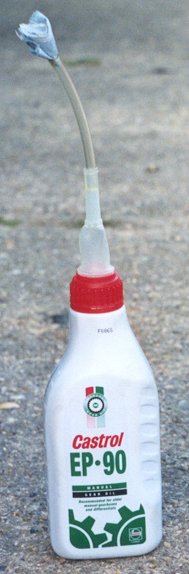 After trying various things I have found the most satisfactory way of filling up the kingpins is to find
a piece of tube (Boots winemaking siphon tube actually !) that can be pushed into the "air release" hole
in the top of the kingpin, and also miraculously into the spout of a Castrol EP90 1litre bottle.
After trying various things I have found the most satisfactory way of filling up the kingpins is to find
a piece of tube (Boots winemaking siphon tube actually !) that can be pushed into the "air release" hole
in the top of the kingpin, and also miraculously into the spout of a Castrol EP90 1litre bottle.
The oil can then be gently squeezed in until it emerges from the hole in the oil reservoir.
This is really quick and easy, and ensures complete lubrication. Remember to clean all the muck from around both
filler and air release plugs before removing them, since introducing grit with the oil is somewhat counterproductive!
I have found an old suede brush is ideal for this purpose.
BACK TO THE TECHNICAL MENU
HOME
 This picture shows the top nut and shims removed from the swivel pin.
You will need a 1and7/16 inch open ended spanner for this.
The splines that the top anchor slides on are just visible.
This picture shows the top nut and shims removed from the swivel pin.
You will need a 1and7/16 inch open ended spanner for this.
The splines that the top anchor slides on are just visible.
 Here the top anchor has been withdrawn and the oil seal levered out with a screwdriver.
The thrust race cups have been lifted out using a couple of L shaped bits of stiff wire,
which can be worked under the bottom cup.
The oil reservoir has been cleaned out ready for fitting the new race.
Note that the top of the top swivel pin bush (orange) can be seen in the bottom of the oil reservoir,
if the bushes are worn you will see play here.
Here the top anchor has been withdrawn and the oil seal levered out with a screwdriver.
The thrust race cups have been lifted out using a couple of L shaped bits of stiff wire,
which can be worked under the bottom cup.
The oil reservoir has been cleaned out ready for fitting the new race.
Note that the top of the top swivel pin bush (orange) can be seen in the bottom of the oil reservoir,
if the bushes are worn you will see play here.
 Finally, the bottom race has been dropped into place, the 14 ball bearings are in position
and the top race is ready to be fitted.
Do not be tempted to add a 15th ball!
Finally, the bottom race has been dropped into place, the 14 ball bearings are in position
and the top race is ready to be fitted.
Do not be tempted to add a 15th ball!
 Set the end float to a maximum of 0.003 inches (ie. no pre-load) by inserting or removing shims as required.
Do this without the oil seal or sealing ring in place, to avoid a false reading.
The method of attaching the dial gauge shown here is not recommended because the anchor can move on the splines giving a
false reading if you're not careful. It's better to clamp the gauge to the kingpin nut. Do as I say, not as I do!
When you are happy with the setting, smear the splines with grease to prevent corrosion,
and assemble the unit complete with oil seal and ring.
Set the end float to a maximum of 0.003 inches (ie. no pre-load) by inserting or removing shims as required.
Do this without the oil seal or sealing ring in place, to avoid a false reading.
The method of attaching the dial gauge shown here is not recommended because the anchor can move on the splines giving a
false reading if you're not careful. It's better to clamp the gauge to the kingpin nut. Do as I say, not as I do!
When you are happy with the setting, smear the splines with grease to prevent corrosion,
and assemble the unit complete with oil seal and ring.